Latest posts
-
OpenEval: How Artificial Intelligence Is Redefining Scientific Peer Review
For more than three centuries, peer review has remained the cornerstone of scientific publishing. Despite continuous improvements in editorial management systems, plagiarism detection software, and reviewer databases, the fundamental process has changed very little: reviewers evaluate an entire manuscript and provide an overall recommendation based on their expertise. However, this traditional approach faces growing challenges.…
-
Desk Rejection Checklist for Engineering Journals

Desk rejection is a critical step in the editorial process of engineering journals. With increasing submission volumes, editors need fast and consistent methods to identify manuscripts that do not meet basic scientific standards. This article provides a practical checklist for desk rejection based on scope, novelty, methodological validity, and ethical compliance. Why desk rejection matters…
-
Red Flags in AI-Generated Engineering Manuscripts
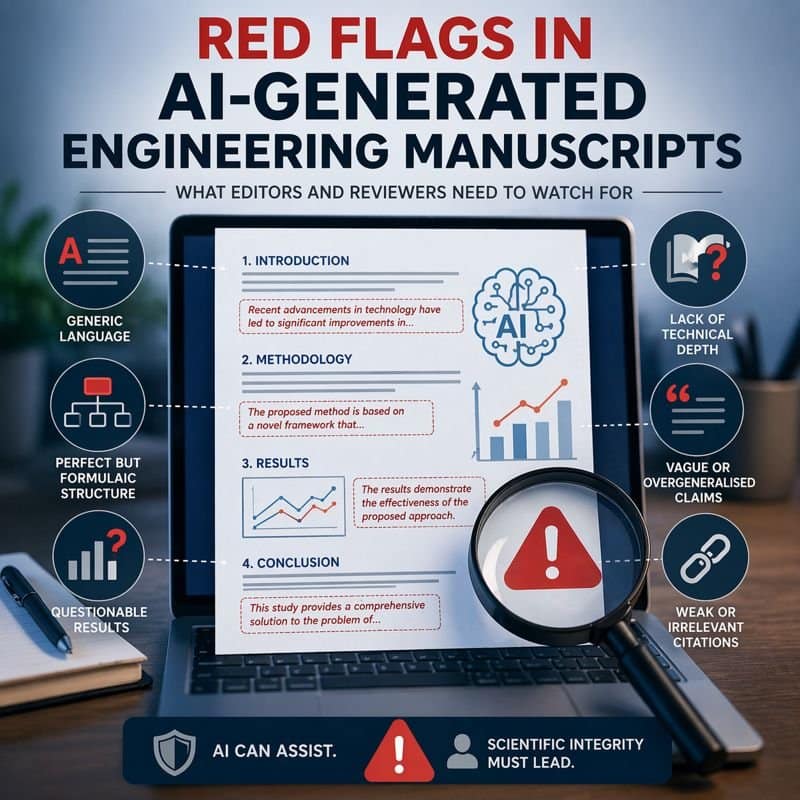
AI-generated manuscripts are becoming increasingly common in engineering journals. While AI can support scientific writing, it can also produce papers that appear valid but lack real technical substance. This article provides a practical framework for editors to identify red flags in AI-generated engineering submissions, focusing on linguistic patterns, structural signals, and technical inconsistencies. What is…
-
How to Detect Paper Mills in Engineering Submissions

Paper mills are increasingly targeting engineering journals with manuscripts that appear technically sound but lack real scientific integrity. For editors, the challenge is no longer identifying poor-quality papers, but detecting sophisticated submissions designed to pass initial screening. This article provides a practical, engineering-focused framework to identify paper mill submissions quickly, using clear editorial signals, methodological…
-
The Evolution of Web of Science: A Pillar in Academic Publishing
Origins of Web of Science The Web of Science (WoS) has its origins in the development of bibliographic databases during the mid-20th century. These early databases aimed to address the increasing complexity and volume of academic literature resulting from advancements in various domains, including science, medicine, and social sciences. One notable figure associated with the…
-
Beyond the Tower: Gustave Eiffel’s Lasting Contributions to Engineering and Architecture

The Man Behind the Tower Gustave Eiffel was born on December 15, 1832, in Dijon, France. He grew up in a family of engineers, which undoubtedly influenced his career choice. Eiffel pursued his education at the École Centrale des Arts et Manufactures, where he graduated as a civil engineer. His early career involved working on…
-
The Great Pyramid’s Precision: Engineering Marvel of Ancient Egypt
The Historical Context of the Great Pyramid The construction of the Great Pyramid of Giza marks a significant period in ancient Egyptian history, particularly during the Fourth Dynasty of the Old Kingdom, around 2580-2560 BCE. This era is characterized by remarkable advancements in architecture and engineering, largely driven by the centralized power of the Pharaohs…
-
Isambard Kingdom Brunel: The Engineer Who Built Britain’s Future
The Legacy of Isambard Kingdom Brunel Isambard Kingdom Brunel is widely recognized as one of the most remarkable engineers of the 19th century, with a legacy that profoundly shaped the landscape of modern engineering and architecture. His innovative approach and daring designs set a benchmark for future infrastructure projects, making significant contributions that transformed public…
-
The Editor-in-Chief Superpower: Mastering the Delegation of Ethical Gray Areas
Understanding Ethical Gray Areas in Journalism Ethical gray areas in journalism represent nuanced situations where the right course of action may not be immediately clear. These dilemmas often arise from complex social dynamics, conflicting interests, and the significant responsibility journalists bear in informing the public. Unlike clear violations of ethical standards, gray areas require careful…
-
Indexation Anxiety: Understanding Why Scopus and WoS Can De-list You – The Silent Killer Metric
What is Indexation Anxiety? Indexation anxiety refers to the significant concern that arises among researchers and academic institutions regarding the status of their academic journals in recognized databases such as Scopus and the Web of Science (WoS). This phenomenon can be understood as the fear or worry that a journal could be de-listed from these…